


Q: First things first. Why are we talking about bonds today?
A: Bond yields (I’ll explain what they are in a moment) have been rising quickly for several months now. In May, the yield on 30-year Treasury bonds hit their highest level since 2007, and while they dipped for about a month afterward, they have climbed even higher since. The yield on 10-year Treasury bonds took a little longer to make headlines, but they recently hit 19-year highs, too, reaching nearly 5% on September 15th.1
These spikes have caused volatility in the stock market, and a flurry of action in Washington.
Q: What are bond yields, and why do they matter so much?
A: First, let’s briefly recap what a bond actually is. When you buy a bond, you are essentially lending money to the bond’s issuer. In return, the issuer promises to pay you a specified rate of interest on a regular basis and then repay the original amount of money after a predetermined length of time. Simple, right?
Sadly, it’s all going to get a little more complex from here. Because now, we move onto a bond’s yield, which is the return an investor expects to gain until a bond matures. Yields can be determined by dividing the bond’s annual interest rate payment by its price. For example, imagine an investor, whom we’ll call Alfred, buys a bond with a 10% interest rate for $1000. The bond’s yield would be 10%, too. But now imagine that Alfred sells that bond to Ethyl a year later…but for $75 more. Since the bond is being traded for more than its original value, the yield would go down to 9.3%. (After all, if Ethyl pays more than Alfred for the same level of interest rate, she’s getting a lower return on her investment than Alfred did.) However, if Alfred sold the bond for less than he originally paid — say, $975 — then Ethyl’s yield would rise to 10.25%.
Based on this example, we can see that yields and bond prices are inversely related. If a bond’s price goes up, its yield will go down. If the price goes down, the yield goes up. Make sense?
Now, you may occasionally hear the media refer to a bond’s yield and its interest rate as essentially one and the same. This isn’t technically true, but it makes things easier to understand. That’s because, most of the time, bond yields and interest rates are directly related. If bond yields go up, interest rates go up.
This is why yields matter. Because they indirectly determine how much it costs to borrow money nearly everywhere else in the financial system.
Want to buy a house? Your mortgage rates are determined by bond yields. Want to buy a car? Same thing. Start a new business? Bond yields are your invisible boss. Student loans? Them, too. Bond yields may not make the world go round, but in a weird, opaque way, they power it all the same.
Now, here is where I should stop and clarify something: It’s not all bond yields that wield this power. When it comes to determining interest rates, it’s the U.S. Treasury market that acts as the wizard behind the curtain. Which brings us to our next question:
Q: Why are U.S. Treasury bonds so important that they drive interest rates?
A: Because the U.S. government spends more than it collects in taxes, it issues Treasury bonds to fund operations, pay for the national defense, make Social Security and Medicare payments, and more. In fact, roughly $1 trillion dollars’ worth of Treasury securities get bought and sold every single day.2 Some of these, known as T-bills, mature in a year or less. Some mature in 2-10 years. These are called T-notes. And some, T-bonds, mature in 30 years. These latter two are auctioned at regular intervals at fixed interest rates, making the total market for U.S. Treasuries worth nearly $30 trillion!3
Why is the Treasury market so big? It’s because the U.S. government has long been considered the most reliable borrower in the world. While our country’s debt level is high (more on this in a moment), no other entity has as good a track record of paying its debts back. As they are often seen as the ultimate “safe harbor” investment, investors all over the world buy U.S. Treasury bonds so they can simultaneously secure their money while also earning interest on it. For that reason, the interest rate it pays on its various bonds are used as benchmarks by both bond investors and other financial institutions. For example, if the U.S. pays, say, a 3% interest rate on a 2-year Treasury note, investors would demand slightly more than that to buy a bond from a less reliable issuer. They’d want a higher return on their investment in exchange for taking on a higher risk of not getting their money back when the bond matures.
How Different Treasuries Influence Interest Rates
Typically, 2-Year Treasuries can affect short-term personal loans and business loans. They can also signal what the market expects the Fed to do with the Federal Funds Rate. 10-Year Treasuries influence borrowing costs for mortgages and autoloans. Finally, 30-Year Treasuries are a barometer for how investors and financial institutions assess the long-term health of the overall economy. As a result, they impact how much other issuers pay in interest on their long-term bonds.4
But in recent months, the U.S. government has had to pay higher and higher interest rates, too, driving Treasury yields to levels we haven’t seen in decades. So, the question is:
Q: What is causing this surge in Treasury yields?
A: If you gathered a group of economists for dinner and asked them this question, you probably wouldn’t get another word in all night. They’d be too busy debating. That’s because there’s no definite answer, no equivalent of 2+2=4.
Think of Treasury yields as a recipe. There are lots of ingredients that go into it, all of which affect the final outcome. But sometimes, the recipe changes a bit here and there. One ingredient takes on more weight than others. Another flavor becomes temporarily dominant. It’s impossible to know the exact ratio of each, but we can still use context to draw some fairly safe conclusions.
Right now, there appear to be three main ingredients. The most obvious is inflation.
You don’t need me to tell you how expensive the cost of living has become. Due largely to the war with Iran, inflation is spiking once again. Oil prices have renewed their flirtation with the $100-a-barrel mark.5 The average price for diesel fuel has risen to well over $6 a gallon.5 As a result, all the goods that depend on oil, or are transported by diesel, are going up in price, too.
What does this have to do with bond yields? Well, if I loan money to the government, I know that, thanks to inflation, my money will not be worth as much by the time I get it back. In normal times, when inflation is fairly low and steady, I may not care all that much. But when inflation is rising, I’d want a higher interest rate as compensation. That drives bond yields up.
Inflation is the most obvious explanation for what’s going on, but it’s not the only one. Another ingredient is the health of the stock market.
Powered in large part by tech companies (especially AI-related companies), the stock market have mostly flashed green for the better part of 2026. So, some economists argue that yields are up because investors simply need a better reason to invest in bonds as opposed to stocks. A hypothetical investor might ask, “If stocks are doing so well, why should I invest in bonds unless you pay me a higher interest rate?” This is a fun, feel-good sort of ingredient, like adding chocolate or a little vanilla to the recipe.
But the final ingredient, and the one both economists and investors are wrestling the most with right now, is debt.
It’s no exaggeration to say that our country is awash in debt. The Federal Reserve estimates that 77% of U.S. adults carry some type of debt; other estimates put the number as high as 90%.6&7 Companies are in debt, too — including the gigantic AI “hyperscaler” companies driving the stock market. (More on this in a moment, too.) But the real whopper is our national debt, which hit $40 trillion in August.8
Now, the subject of our national debt can quickly turn political, but that’s not the point of this message. So, let’s just look at the facts: The national debt is $10 trillion larger than the entire Treasury market…and it grows at a faster rate than the overall economy. Our country pays more interest on its debt than it spends on anything except Social Security and Medicare.
I mentioned earlier that the U.S. is considered the most reliable borrower in the world. But when the debt level gets this high, investors start to wonder: “Is that still the case? Is this sustainable? Is it possible I might not actually get my money back?” Because of those questions, those doubts, investors may start to see buying Treasury bonds as at least somewhat risky rather than risk-free. Which means they demand more interest.
In recent weeks, the government has tried to influence all this by buying billions in long-term Treasury bonds back from investors. This was meant to bring down yields by pushing the price of bonds higher. (Remember, when bond prices rise, yields fall, and vice versa.) But just as a five-pound weight can’t compare to a fifty-pounder, billions are nothing compared to trillions. As a result, the effect was small and short-lived.
Still, it’s important to remember that bond yields are a recipe. If something happens in the short-term that alters the recipe (like the Iran war coming to a sudden conclusion, which could help inflation), yields could definitely come down on their own.
But it’s fair to say that yields could also remain high for some time. Which brings us to:
Q: Why should I care about any of this?
A: As we’ve discussed, higher yields often lead to higher interest rates for everyday life. The immediate consequences become obvious for anyone who needs to borrow money.
But there are potentially deeper and longer-term ramifications, too. (Note that I said potentially, because we are now moving from discussing what has happened to preparing for what could happen.) To understand what those are, let’s go back to the weight-lifting analogy.
The stronger a person is, the more weight they can lift. The more weight they can lift, the stronger they can become. A simple syllogism. But when the weight gets too heavy, too fast, or is lifted for too long, strength can fail. Injuries and setbacks can happen. It’s why no one would go to the gym and try to lift 250 pounds when their previous record was 150.
Right now, our economy appears to be on solid footing. GDP growth was positive, if modest, through the first two quarters.9 The unemployment rate sits around 4%, which it has done for some time.10 But think of Treasury yields, and interest rates in general, as weights. What happens when too much weight gets piled on, either too quickly, or for too long?
This is not a merely academic question, even when it comes to the stock market. Remember what I said about stocks being driven by AI companies, especially hyperscalers? Hyperscalers are companies that provide enormous amounts of computing power to the companies that actually create and train AI. Most have names you’d recognize, like Amazon, Microsoft, Google, Oracle, etc. These companies have been consistently responsible for the bulk of the stock market’s growth in recent years. But they are spending hundreds of billions each year to provide this computing power necessary for AI…and racking up tens of billions in debt in order to finance that spending.12
Imagine that for a second. The stock market is powered by a handful of companies. That handful spends a lot. In order to spend that much, these companies issue their own bonds on top of other forms of credit financing…at a time when interest rates are skyrocketing. That makes it harder and harder to pay off their debt. (Furthermore, many AI companies — the customers of these giant hyperscalers — have not consistently been profitable.)
Not All Interest Rates Are Tied to Treasury Yields
While Treasury yields have a huge role in determining other interest rates, they are not the only player at the table. The Federal Funds Rate, set by the Federal Reserve, has a major impact, too. The FFR is the interest rate that banks pay each other for overnight loans. When the Fed raises this rate — which it recently did on September 16 in order to combat inflation11 — it costs more for banks to loan each other money. So, in response, banks raise their own interest rates. That’s why, when the Federal Reserve raises the federal funds rate, the prime rate goes up as well, which affects credit cards, HELOCs, and short-term CD rates, among other things.
You can probably see why all of this feels like the weight-lifter whose arms are starting to wobble. But there’s one other question we have to ask before we get to the final question.
Q: What if interest rates aren’t actually high, but rather…going back to normal?
A: Here’s a funny truth: Throughout this message, we’ve been talking about the possible ramifications of rising treasury yields and higher interest rates. But historically, rates really aren’t that high at all.
Take a look at these two charts. The first shows how the yield on 10-year U.S. Treasuries has changed over the decades.13 The second shows the history of the Federal Funds Rate.14 Both paint a similar picture. In 2007, interest rates began dropping as the world entered the Great Recession. It was the beginning — depending on how you look at it — of a two-decade era of ultra-low interest rates. For years, debt has been cheap. Financing has been easy. The markets have been flooded with liquidity. (I’ll link to both of these charts at the end so you can examine them in greater detail, if you like.)
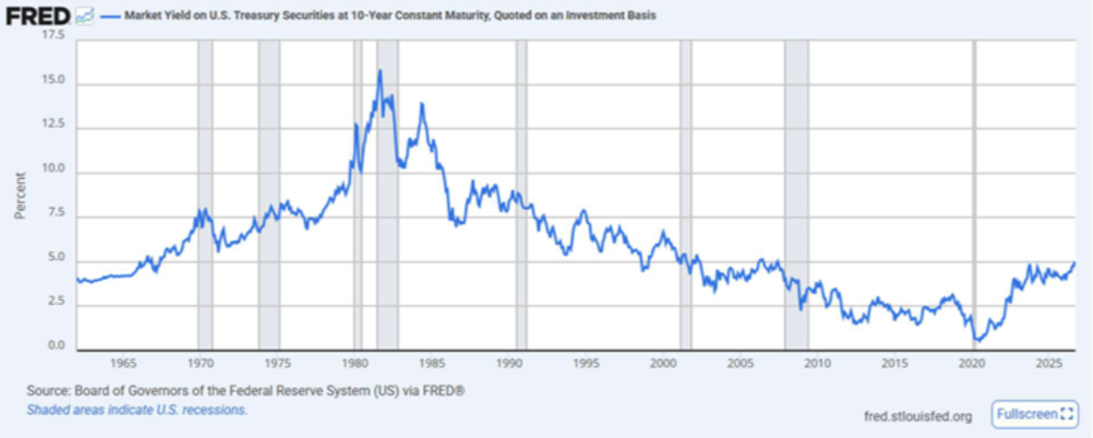
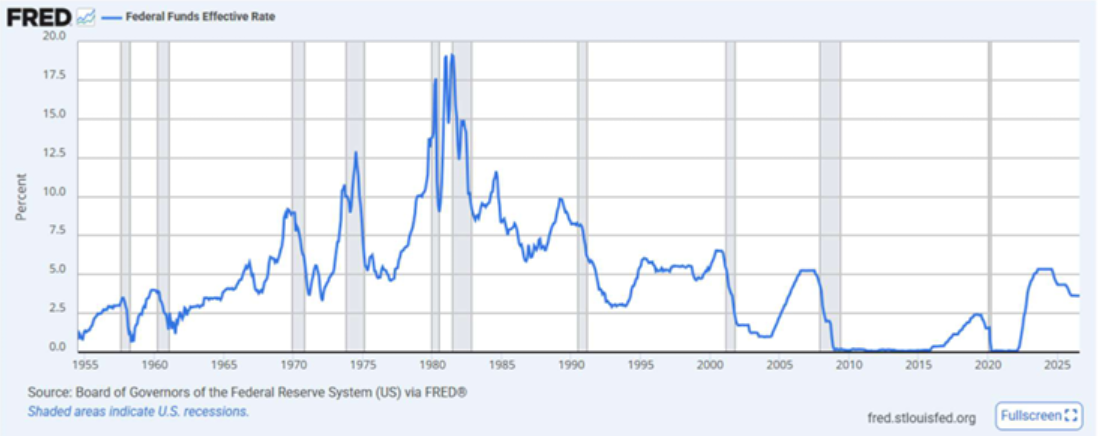
Prior to 2007, interest rates, whether dictated by the Fed or by Treasury yields, were much higher on average. Sometimes much, much higher. (If you bought a house in the eighties or nineties, the price may have been much lower than today, but the interest rate you paid on your mortgage was probably much higher.)
In recent years, treasury yields and interest rates have creeped up again. There are still dips and swings, as you can see, but it prompts the question: What if interest rates are really just getting back to normal? What if an ultra-low interest rate environment was just a phase in history, like skinny jeans, arcades, or drive-in movie theaters?
If that’s true (and understand, this is just a possibility, not a prediction) it would certainly have ramifications for the stock market. Companies and investors have both become used to low-interest rates. If high(er) rates are permanent, though, companies and investors may have to be more careful with capital if access to financing, or the ability to pay it back, becomes harder than it used to be. Would that have an effect on growth? Possibly, but we have to remember that the stock market is a recipe, too, one that’s influenced by dozens of ingredients.
In any event, we do not know what the future holds. We cannot know. Treasury yields and interest rates could stay elevated; they could come back down. The markets could wobble; we could also learn that they are strong enough to lift a lot more weight.
Q: So, what do we actually do with all this information?
A: Given how important Treasury yields are to our financial system, and the possibility that this will be a story that changes rather than ends, I wanted to make sure I gave you a comprehensive look at what’s going on and why it matters. But while more info is always a good thing, it’s not always clear what we should do with it.
To answer that, let’s return to my weight-lifting analogy one more time.
Imagine you have complete, unrestricted access to all the equipment in a gym. Every free-weight, every machine. Imagine the emotions that might trigger. It would be easy to get overly-excited and just start using everything willy-nilly, hoping to achieve whatever gains or results you want in record time. But as you know, such an approach would probably be unsuccessful…and maybe even unsafe.
Or you might feel completely overwhelmed. You might stick to only one or two things; exercises you understand or already have experience with. Maybe you just leave the gym altogether.
When we lift weights, we need to do it thoughtfully, carefully, systematically. Never lift more weight than we can handle. Work all the major muscle groups (don’t skip leg day) and pay attention to proper form. Avoid overtraining but also be mindful of plateauing if we don’t push ourselves. Thankfully, the more informed we are, the more we understand the what and the why behind every exercise, the better we can check all those boxes.
That same, measured approach works for investing. We must always be careful not to give our emotions free reign over our actions. We must avoid overreacting to scary-sounding headlines, whether they’re about bond yields going up, or oil, or inflation, or anything else. At the same time, we must be mindful about not getting over-exuberant — about AI, the stock market, you name it.
And the best way to do that is with information, too. If we know the why behind the headlines, we can protect ourselves from overreacting to them. And if we are aware of the risks and challenges of a high-interest rate environment, we can prevent ourselves from ever being surprised by them.
That’s what we do with all this information: we use it as a compass, or a leveler; as a gimbal or a wedge. Something to keep us steady, balanced, and on-course.
This is an interesting period to be an investor, because there are so many ingredients to weigh and sort; so many storylines to study and ponder. The good news is that, while that can all create uncertainty, it can also create opportunity. That’s why I remain optimistic about your long-term goals and the strategy we’ve put in place to help you achieve them.
As always, I will keep you updated on what’s going on in the markets. In the meantime, please let me know if you ever have any questions or concerns.
Content in this material is for general information only and not intended to provide specific advice or recommendations for any individual.
Government bonds and Treasury bills are guaranteed by the US government as to the timely payment of principal and interest and, if held to maturity, offer a fixed rate of return and fixed principal value.
SOURCES:
1 “Market Yield on U.S. Treasury Securities at 10-Year Constant Maturity,” Federal Reserve Bank of St. Louis,
https://fred.stlouisfed.org/series/dgs10
2 “Remarks by Secretary of the Treasury Scott Bessent before the Treasury Market Conference,” U.S. Department of the Treasury,
https://home.treasury.gov/news/press-releases/sb0314
3 “Who’s buying U.S. Treasury debt, and why?” Brookings, https://www.brookings.edu/articles/whos-buying-u-s-treasury-debt-and-why/
4 “Know your bonds: A quick guide to Treasuries,” CNN Business, https://www.cnn.com/2026/09/10/economy/bond-market-treasury-explained
5 “U.S. diesel prices soar past $6 a gallon,” Associated Press, https://apnews.com/article/diesel-prices-record-iranwar636252b3b82326b41661ee5c4073dacb
6 “Ever Wonder What Percentage of Americans Are in Debt?” National Debt Relief,
https://www.nationaldebtrelief.com/blog/financialwellness/credit-score/ever-wonder-what-percentage-of-americans-are-in-debt/
7 “The Demographics of Household Debt in America,” Debt.org, https://www.debt.org/faqs/americans-in-debt/demographics/
8 “What is the national debt?” U.S. Department of the Treasury, https://fiscaldata.treasury.gov/americas-finance-guide/national-debt/
9 “GDP and Corporate Profits, 2nd Quarter 2026,” Bureau of Economic Analysis, https://www.bea.gov/news/2026/gdp-second-estimateandcorporate-profits-2nd-quarter-2026
10 “Economy at a Glance – Unemployment Rate,” Board of Governors of the Federal Reserve System,
https://www.federalreserve.gov/economyat-a-glance-unemployment-rate.htm
11 “Federal Reserve issues FOMC statement,” Board of Governors of the Federal Reserve System,
https://www.federalreserve.gov/newsevents/pressreleases/monetary20260916a.htm
12 “The AI buildout rests on hidden debt,” GIS, https://www.gisreportsonline.com/r/ai-buildout-hidden-debt/
13 “Market Yield on U.S. Treasury Securities at 10-Year Constant Maturity,” Federal Reserve Bank of St. Louis, (Max View),
https://fred.stlouisfed.org/series/dgs10
14 “Federal Funds Effective Rate,” Federal Reserve Bank of St. Louis, (Max View), https://fred.stlouisfed.org/series/fedfunds